Try The Pastor’s Research Assistant free for four days. No credit card required.
Start freeIn a class by itself
A great sermon doesn’t begin in the editor.It begins in the text.
Disciplined, thorough exegesisThe careful work of drawing a passage’s original meaning out of the text itself.. Effective, insightful hermeneuticsInterpreting a passage faithfully and carrying its meaning into the present.. That’s where great sermons begin, and where every other tool leaves you on your own.
Most tools start at the editor.The Pastor’s Research Assistant starts at the text.
Every other tool hands you a better place to type. None of them help with the hardest and most important work, the text itself. The Pastor’s Research Assistant is built the other way around: it begins where the sermon begins.
Your own research assistant.
The Pastor’s Research Assistant does the work of gathering, curating, and synthesizing the rich meaning of the text, the reading that fills a shelf of commentaries, lexicons, and journals, done in minutes. It gives you back the time, and the tools, to study, reflect, pray, and prepare.
Your calling deserves your best hours.
The Pastor’s Research Assistant takes on the gathering, the language work, and the historical digging, and returns those hours to you for study, prayer, reflection, and the shaping of the message. The research informs your judgment; the sermon carries your voice, your convictions, and your knowledge of the people you serve, because it was formed in the work that only happens between you, the text, and the Lord.
And it doesn’t stop there. The Pastor’s Research Assistant joins that exegeticalHaving to do with exegesis: drawing a passage’s original meaning out of the text itself. and hermeneuticalHaving to do with hermeneutics: interpreting a passage faithfully for today. depth with superior sermon editing and exceptional homileticalHaving to do with homiletics: the craft of preaching. coaching, so the same place that opens the text also helps you carry it to the pulpit, week after week.
The Pastor’s Research Assistant isn’t just another editing tool. It’s in a class by itself.
Everything between the text and the pulpit, in one place.
Twenty-one research assistants, each reaching into the work of hundreds of biblical scholars, collecting, collating, curating, and synthesizing it into one complete study, in minutes.
Many texts, one message, new Synthesis weaves several of your studies into one preach-ready whole, or distills them into a tight summary.
From blank page to pulpit, a ten-stage coach that carries the research and the structure, so the sermon comes out in your own voice.
Illustrations written, not just suggested, biblical, historical, and contemporary, told in full and ready to preach.
Every preaching tool in one place, manuscript, outline, slides, and a speaker’s card, generated from your own work.
Preach from a tablet, distraction-free Podium mode: large, calm, and timed.
Grow in your study skills, learn exegesis, hermeneutics, and homiletics in our built-in learning library, for those new to interpretation and preaching, or still growing in the craft, foundations to advanced, included at no extra cost.
Never lose a good thought, save notes as you study and find any of them in a keystroke, search by word or by #hashtag, with a clickable tag index that groups everything you have kept.
21 outputs · every translation · the full lectionary, for Sunday, the seminary, or the small group.
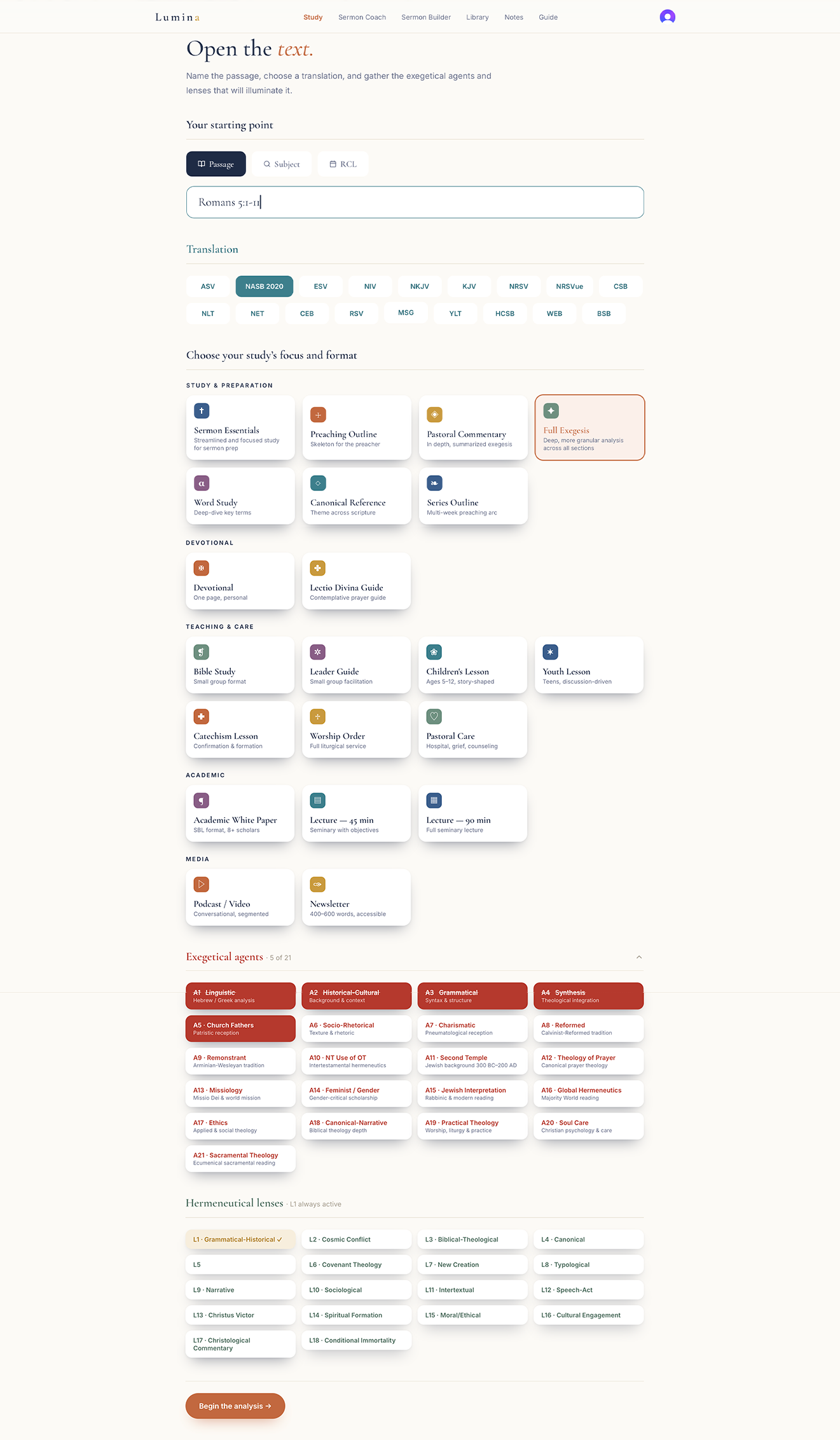
The Study
Imagine having a research assistant able to consult hundreds of scholars, applying the exegetical and hermeneutical tools and perspectives that building theologically rich, meaningful and relevant sermons relies on.
You choose your passage(s) or subject, or even lectionary readings, choose the translation you prefer, the exegetical agents and hermeneutical lenses suited best to your message, and your research assistant goes to work, reaching into the writing of the field’s leading scholars: every key term, every historical detail, every theological thread, collected, cross-checked, and synthesized into one complete study. The Pastor’s Research Assistant makes that possible.
The reading that fills a shelf of commentaries, done and gathered into something you can actually preach from.
Exegesis is the work of drawing out what a passage originally meant; hermeneutics is interpreting it faithfully for today.
The Outputs
One study. Twenty-one ways to use it.
From a single analysis, generate the exact form you need, for the pulpit, the lectern, the small group, or the inbox. Each one drawn from the same deep study, in the register its audience needs.
Sermon Essentials
A streamlined exegesis with plain-language insights, sermon ideas, and structure. No setup: enter your passage and go.
Preaching Outline
Skeleton for the preacher
Pastoral Commentary
In depth, summarized exegesis
Full Exegesis
Deep, more granular analysis across all sections
Word Study
Deep-dive key terms
Canonical Reference
Theme across scripture
Series Outline
Multi-week preaching arc
Devotional
One page, personal
Lectio Divina Guide
Contemplative prayer guide
Bible Study
Small group format
Leader Guide
Small group facilitation
Children’s Lesson
Ages 5–12, story-shaped
Youth Lesson
Teens, discussion-driven
Catechism Lesson
Confirmation & formation
Worship Order
Full liturgical service
Pastoral Care
Hospital, grief, counseling
Academic White Paper
SBL format, 8+ scholars
Lecture: 45 min
Seminary with objectives
Lecture: 90 min
Full seminary lecture
Podcast / Video
Conversational, segmented
Newsletter
400–600 words, accessible
A sample, Full Exegesis
Full Exegesis · Philippians 2:5–11
The Mind of Christ
I. Linguistic Analysis
The hymn turns on three verbs. ἐκένωσεν (ekenōsen, “emptied himself,” v. 7) does not mean Christ shed deity but poured himself out in self-giving; ἐταπείνωσεν (“humbled,” v. 8) names the voluntary descent; and ὑπερύψωσεν (“highly exalted,” v. 9) the Father’s answer…
II. Historical-Cultural Background
First-century readers in a Roman colony like Philippi prized status and honor above almost all else. Against that backdrop, a Lord who takes the μορφὴ δούλου, the form of a slave, would have landed as scandal and glory at once…
III. Grammatical & Structural
The passage is a single, soaring sentence built as descent (vv. 6–8) and ascent (vv. 9–11), hinged on the “therefore” of v. 9. The imperative of v. 5 governs all that follows: this mind is to be in you…
IV. Theological Synthesis
The hymn grounds ethics in Christology: because the One who was in the form of God chose the form of a servant, self-emptying love is not a strategy but the very shape of God’s own life, and therefore of ours…
…continues through Lens Analysis, Hermeneutical Bridge, and a 12-source Bibliography.
Every output, ready to use
The honest reality
Ministry is relentless. The pastoral week is full before sermon preparation begins.
The scholarship exists, in commentaries, lexicons, and journals that take many hours to collect the relevant information from, before real studying, reflection, and prayer even begins. Most ministers simply don't have the time, or a research assistant to do that.
Let The Pastor’s Research Assistant carry the legwork, so you’ll have the time to reflect, pray and prepare in the way you’d like.
The vision
What becomes possible when pastors, regardless of their church’s size or their harried and hurried schedules, can engage the text with the depth of research, study, and assistance they secretly dream of?
What would that do to preaching?
What would that do to the people who hear it week after week?
What would that do to the surrounding communities those people call home?
Greater joy is found in sermon preparation and teaching.
Congregations are more deeply enriched.
The neighboring community is more deeply impacted.
SynthesisNew
Many texts. One message.
Some sermons rest on a single passage. Others gather a theme that runs across the whole of Scripture. When your message spans several texts or subjects, Synthesis brings the studies you have already run together into one. The Pastor’s Research Assistant draws out the unifying thread, weaves the exegesis into a single coherent study, and hands it straight to the Sermon Coach. Or, when you simply need the gist, it condenses a stack of studies into one tight, readable summary.
Combine, don’t juggle
Pick several studies and The Pastor’s Research Assistant weaves them into one unified foundation, the common theme surfaced and the overlap resolved for you.
Built to preach from
Send the combined study straight into the Sermon Coach and build a single message drawn from many texts.
Or distill it
Turn a shelf of studies into one quick digest you can absorb in minutes, the full depth intact.
The Sermon Coach
Build your sermon in the light of the full text
Other tools just give you somewhere to edit a sermon. The Pastor’s Research Assistant gives you the tools, and step‑by‑step coaching across ten stages, and a detailed sermon‑review process, walking you through building your own.
The sermon that comes out carries your voice, your structure, and your words.
The ten stages
Stage 3 of 10
The Big Idea
Your coach
Every point, illustration, and application exists to serve this one sentence. Choose the candidate that most faithfully carries the text.
Candidate A
Because Christ emptied himself for us, we are free to pour ourselves out for one another.
Candidate B
The humility of Christ is the pattern and the power of life together in the church.
Candidate C
God exalts the One who descends, and calls us down the same road to glory.
The Sermon Builder
This is where your sermon comes alive.
The coaching is done. Now you build the thing you’ll actually preach; and everything you need is already in the room.
Title
The Mind of Christ
Big Idea
Because Christ emptied himself for us, we are free to pour ourselves out for one another.
Introduction
A Roman colony measured a person by status. Then Paul sings of a Lord who let it all go…
Point One · Illustration
On the night before the cross, Jesus knelt with a towel and a basin and washed the feet of the men who would abandon him. The God who flung the stars stooped to the dust between a man’s toes, and said, “I have given you an example.”…
Conclusion
So have this mind among yourselves, the mind that was, and is, in Christ Jesus.
Your sermon doesn’t land as a wall of text. It opens as living, movable blocks: Title, Big Idea, every Point, the Conclusion. Grab one and move it. Rewrite a line until it sounds like you.
Stuck for an illustration? Name the block “Illustration” and a full, preachable story appears, biblical, historical, or drawn from ordinary life. Name one “Conclusion” and The Pastor’s Research Assistant drafts three ways to land the plane. And your study never leaves the room: your notes, every analysis you’ve run, and a fresh second-opinion review are all a click away.
The Mind of Christ
Have this mind among yourselves, which is yours in Christ Jesus,
who, though he was in the form of God, did not count equality with God a thing to be grasped,
but emptied himself, taking the form of a servant…
Podium mode turns your tablet or phone into the pulpit: scroll your outline or full manuscript, slide out the margin tab for the speaker’s notes you added, and watch a running timer, in day or night mode.
Outlines that preach
Hand The Pastor’s Research Assistant your blocks; get back a clean preaching outline, points, sub-points, transitions, ready for the pulpit.
A card for the glance
Title, Big Idea, every point with its verses, the call, the closing line, one card, built to glance at, not read.
Slides, already made
Presentation slides generated straight from your blocks, formatted and ready to drop onto Sunday’s screen.
Preach from a tablet or phone
Scroll your outline or full manuscript, slide out the margin tab for your speaker’s notes, keep an eye on the running timer, in day or night mode.
Your study, never a tab away
Notes, past analyses, and an on-demand whole-sermon review, all right inside the editor while you write.
Out the door in one click
Word, PDF, PowerPoint, clean, formatted, Scripture in your translation. Print it, project it, send it.
The Learning LibraryNew
Grow in your study and sermon-crafting skills.
Grow in your study skills by learning more about exegesis, hermeneutics, and homiletics with our built-in learning library, created for those new to interpretation and preaching, or still growing in these important skills. From foundations to advanced, with worked examples on real passages. You will find this a helpful resource in your work as a pastor, and it is included in your subscription at no additional cost.
Exegesis
Drawing the meaning out of the text the author actually wrote: observation, words, genre, context, and the careful use of commentaries.
Hermeneutics
Interpreting faithfully: the grammatical-historical method, bridging the gap to today, seeing Christ rightly, and avoiding the common pitfalls.
Homiletics
Turning study into a sermon: finding the Big Idea, structure, illustration and application, the narrative arc, and honest self-critique.
The Preaching CalendarNew
Plan your preaching, a season or a year ahead.
Follow the Revised Common Lectionary (Year A, B, and C) with the readings for every Sunday, or keep a traditional calendar for your own series, then carry each Sunday from study to the pulpit.
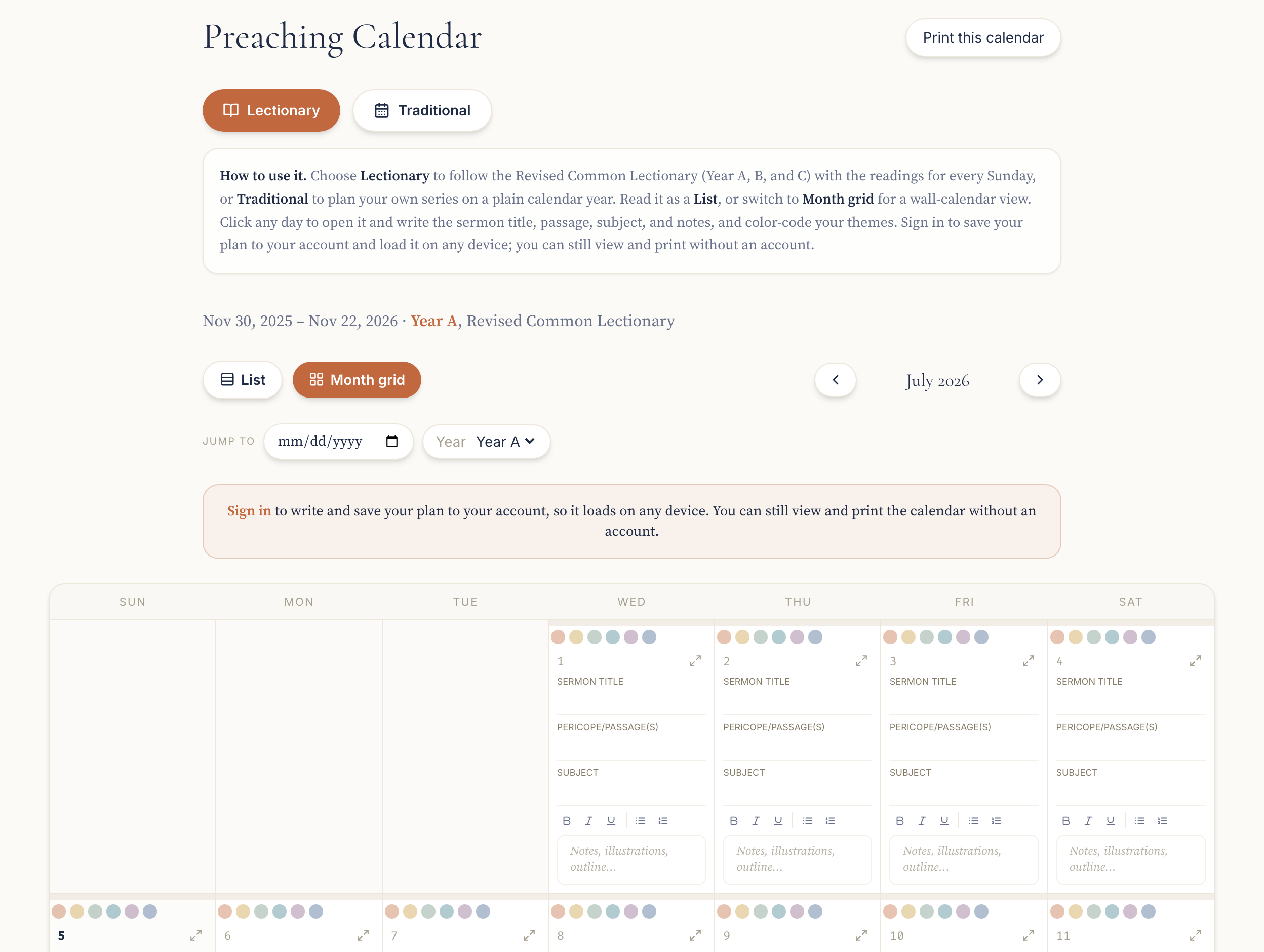
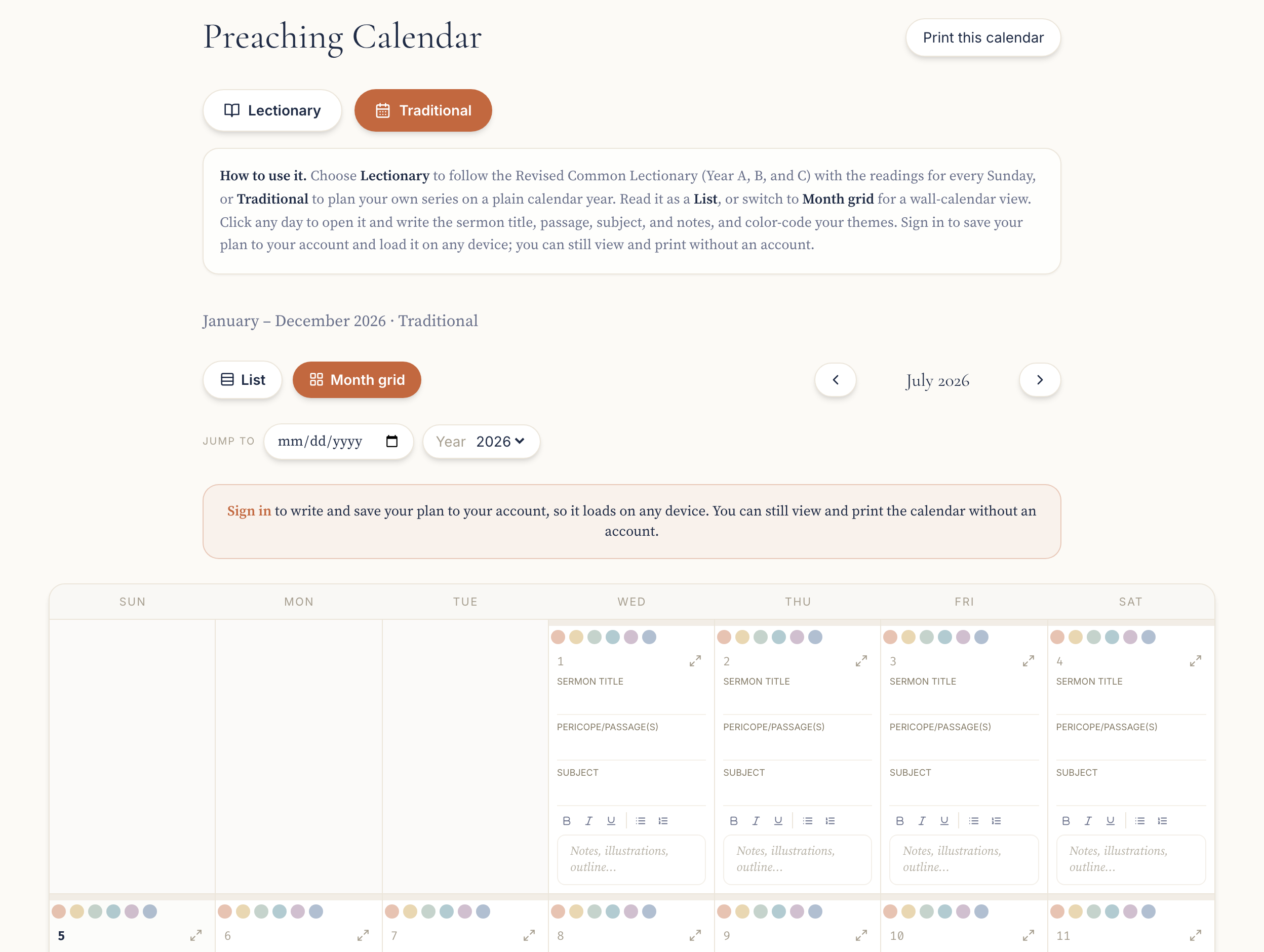
- Lectionary (Year A/B/C) and traditional calendars
- A season-by-season list, or a full month-grid view
- The RCL readings on every Sunday, First, Psalm, Second, Gospel
- Easter and every holy day marked for you
- Title, pericope/passage(s), subject, and rich-text notes on every day
- A color bar to code your series and themes
- An optional midweek service day
- Jump to any date or lectionary Year (A/B/C), no scrolling
- Saved to your account, on any device, and prints any time
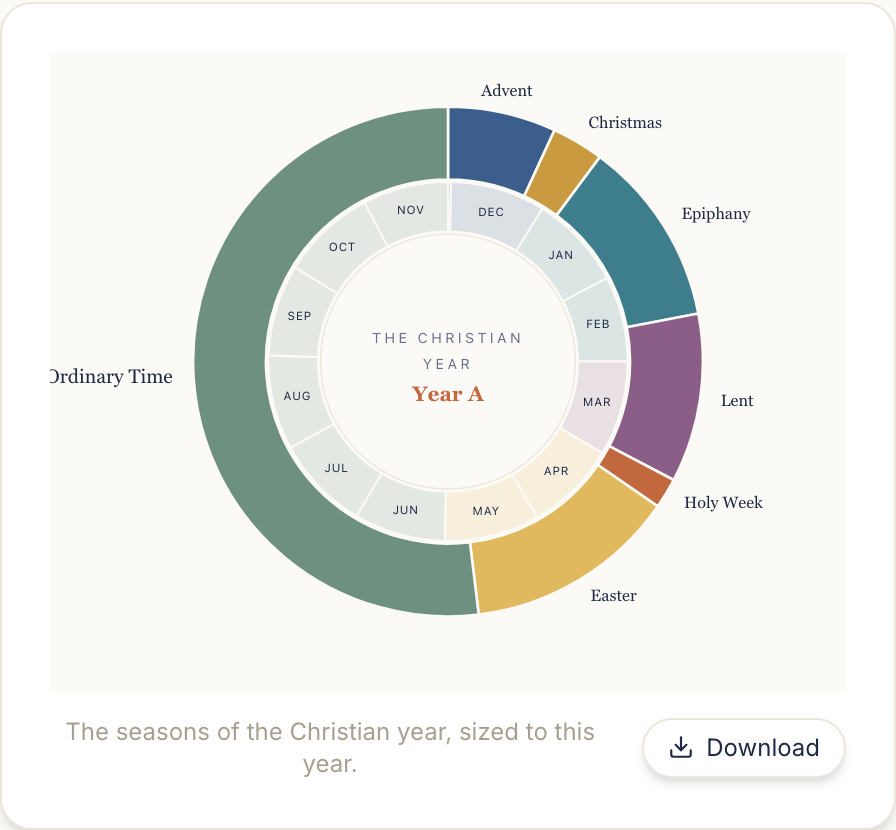
- A church-year wheel you can view and download
It flows from your sermons
From the Sermon Coach and the Sermon Builder, one click, “Add to preaching calendar”, drops that sermon’s title, passage, and theme onto the Sunday you choose. Your study, your sermon, and your plan stay in one place.
2 Timothy 2:15 (NASB)
“Be diligent to present yourself approved to God as a workman who does not need to be ashamed,
accurately handling the word of truth.”
Light for the preaching ministry
Begin
Enjoy enriching, deep, full, and engaging study.
Build engaging, relevant and effective sermons more easily and enjoyably.
Try The Pastor’s Research Assistant for free for four days, no card required. See for yourself the difference hiring The Pastor’s Research Assistant as your research assistant can make.
No credit card required to start. Cancel anytime.