Try The Pastor’s Research Assistant free for four days. No credit card required.
Start freeFeatures
The full apparatus of biblical scholarship,
organized for Sunday
Twenty-one exegetical and analytical agents. Eighteen hermeneutical lenses. Twenty-one output formats. The Sermon Coach. Together they are one thing: your research assistant, doing the gathering, curating, and synthesizing, so the study, the voice, and the sermon stay yours.
Twenty-one research assistants, each reaching into the work of hundreds of biblical scholars, collecting, collating, curating, and synthesizing it into one complete study, in minutes.
Many texts, one message, new Synthesis weaves several of your studies into one preach-ready whole, or distills them into a tight summary.
From blank page to pulpit, a ten-stage coach that carries the research and the structure, so the sermon comes out in your own voice.
Illustrations written, not just suggested, biblical, historical, and contemporary, told in full and ready to preach.
Every preaching tool in one place, manuscript, outline, slides, and a speaker’s card, generated from your own work.
Preach from a tablet, distraction-free Podium mode: large, calm, and timed.
Grow in your study skills, learn exegesis, hermeneutics, and homiletics in our built-in learning library, for those new to interpretation and preaching, or still growing in the craft, foundations to advanced, included at no extra cost.
Never lose a good thought, save notes as you study and find any of them in a keystroke, search by word or by #hashtag, with a clickable tag index that groups everything you have kept.
21 outputs · every translation · the full lectionary, for Sunday, the seminary, or the small group.
21 Exegetical/Analytical Agents
Exegesis is the careful work of drawing a passage’s original meaning out of the text itself; the analytical agents broaden that work across history, language, and theology. Each agent brings a distinct scholarly tradition to the text.
A1 through A4 are active by default. The others are available as needed, for the passage, the audience, and the occasion.
Linguistic
For every key word: original term, transliteration, root, morphological parsing, semantic range, and contextual function. Significant translation differences noted. Hapax legomena and contested constructions flagged. Cites BDAG, HALOT, BDB, Louw-Nida, TDNT, Wallace.
Historical-Cultural
Date, authorship, audience, occasion. Social and cultural dynamics, honor-shame, patron-client, religious landscape. ANE parallels (OT) or Greco-Roman / Second Temple Jewish parallels (NT). Cites Keener, Witherington, Heiser, Wright, Walton.
Grammatical-Structural
Main clauses and subordinate relationships. Genre and interpretive implications. Literary structure: chiasm, inclusio, parallelism. Key grammatical features: verb tenses, participles, conditionals, imperatives, divine passives. Cites Wallace (GGBB), Runge.
Theological Synthesis
Synthesizes all prior analysis into: the author's original intent, primary theological themes, canonical and redemptive-historical significance, and hermeneutical principles for bridging the original meaning to today.
Early Church Fathers
Apostolic Fathers, Ante-Nicene Fathers, Nicene and Post-Nicene Fathers. Patristic hermeneutical methods: Antiochene vs. Alexandrian schools. Rule of Faith alignment. Doctrinal contribution. Cites ANF, NPNF, ACCS (IVP), Thomas Oden.
Socio-Rhetorical
Full five-texture methodology (Robbins / Witherington): Inner texture, Intertexture, Social and Cultural texture, Ideological texture, Sacred texture. Full rhetorical analysis: species, units, appeals.
Charismatic / Pneumatological
Classical Pentecostal, Charismatic Renewal, and scholarly engagement. Gordon Fee, Sam Storms, Craig Keener, Peter Davids, Wayne Grudem, J. Rodman Williams, Richard Lovelace, Dennis Bennett, Terry Fullam, Amos Yong.
Reformed
Van Til, Berkhof, Hodge, Horton, Frame, Wainwright (Doxology), Vos, Kline, Moo, McGrath, Barth. Hermeneutical presuppositions, Doctrines of Grace, covenant theology, Reformed biblical theology.
Remonstrant / Arminian
Arminius, Wesley, Olson, Oden, Witherington, J. Rodman Williams. Prevenient grace, conditional perseverance, synergism. Honest engagement with the Calvinist-Arminian exegetical debate.
NT Use of the OT
Direct quotations, deliberate allusions, thematic echoes. MT vs. LXX variants. Hermeneutical methods: direct quotation, pesher, typology, midrash, narrative recapitulation. Beale & Carson, Hays, Fishbane.
Second Temple Judaism
Dead Sea Scrolls, Pseudepigrapha, Philo, Josephus, Targumim, early rabbinic traditions. Jewish eschatological expectations. The world Jesus and Paul inhabited. Wright, Keener, Collins, Charlesworth.
Biblical Theology of Prayer
Canonical prayer arc from Abraham through Revelation. Vice-regency dimension. Psalter, Gethsemane, Pauline prayer theology, the incense-bowl imagery. Carson, Forsyth, Keller, Wink, Goldsworthy.
Missiology
Missio Dei, scope of redemption, cross-cultural witness, the sending community. Christopher Wright, David Bosch, Lesslie Newbigin, Andrew Walls, Lamin Sanneh.
Feminist / Gender-Critical
Gender in the world of the text. Full spectrum from complementarian to post-Christian feminist. Cohick, Westfall, Fee, Trible, Schüssler Fiorenza, Schreiner. Even-handed scholarly presentation.
Jewish Interpretation
Talmudic, medieval (Rashi, Maimonides, Nachmanides), and modern Jewish scholarship. Jewish-Christian dialogue. Amy-Jill Levine, Levenson, Fishbane, Heschel. What Jewish reading reveals that Christian exegesis misses.
Global / Majority World
African (Bediako), Latin American (González), Asian, Pentecostal global, and post-colonial readings. What Majority World hermeneutics surfaces that Western exegesis has marginalized.
Ethics & Applied Theology
Individual and communal ethics. Social and political dimensions. Virtue ethics and character formation. Specific contemporary applications. Hays, O'Donovan, Hauerwas, Christopher Wright, Stassen.
Canonical-Narrative
Biblical theology depth: creation to new creation. Covenant structure as narrative backbone. Typological threads. Christological culmination. Goldsworthy, Beale, Schreiner, Dempster.
Practical Theology & Worship
Passage and corporate worship. Sacramental theology. Preaching and proclamation. Formative practices. Wainwright (Doxology), James K.A. Smith, Schmemann, Webber, Willard, Peterson.
Soul Care / Psychology
Inner life and attachment. Shame and honor. Grief and lament. Spiritual formation and psychological change. Curt Thompson, Benner, Allender, Longman, Peterson, Oden.
Sacramental Theology
Baptism, Eucharist, and the sacramental imagination across the traditions: Catholic, Orthodox, Anglican, and Reformed. Sign and reality, real presence, covenant signs. Schmemann, de Lubac, Wainwright, Hunsinger, Leithart.
18 Hermeneutical Lenses
Hermeneutics is the work of interpreting a passage faithfully and carrying its meaning into the present. Each lens brings one interpretive perspective to that work.
L1 (Grammatical-Historical) is always active, the foundation. Every other lens layers additional perspective on top of that foundation. Mix and match for the passage.
Grammatical-Historicalalways on
Foundation, always active. Original language, authorial intent, historical context.
Cosmic Conflict & Vice-Regency
Powers, spiritual authority, regental prayer, the fall as cession, John's dethroning arc.
Biblical-Theological
Redemptive-historical arc: creation, fall, redemption, new creation.
Canonical
Whole-canon relationships, Rule of Faith, intertextual canonical shaping.
Christological / Christotelic
How the passage points toward, is fulfilled in, or is reframed by Christ.
Covenant Theology
Covenantal structure: Abrahamic, Mosaic, Davidic, New Covenant.
New Creation
Eschatological renewal: cosmic, embodied, material dimensions of redemption.
Typological
Persons, events, institutions as divinely-intended prefigurations.
Narrative / Literary
Genre, literary artistry, rhetoric, plot, characterization.
Sociological
Honor-shame, patron-client, purity, kinship, power structures.
Intertextual
Quotations, allusions, echoes; relationships to precursor and successor texts.
Speech-Act Theory
Locution, illocution, perlocution: what the text does, not just what it says.
Christus Victor
The atonement as cosmic conquest, Christ defeating sin, death, and the powers.
Spiritual Formation
How the passage shapes the interior life: prayer, contemplation, virtue, and transformation.
Moral / Ethical
The moral sense of Scripture, what this passage demands ethically and morally.
Cultural Engagement
How the passage speaks to contemporary culture: pluralism, secularism, justice, post-Christian questions.
Reception History
How this passage has been read across church history, patristic, medieval, Reformation, and modern, and what that history of interpretation reveals.
Conditional Immortality / ECT
Final human destiny and the nature of the soul: eternal conscious torment and conditional immortality presented faithfully and at their strongest, side by side, across the patristic, Reformation, and modern spectrum.
SynthesisNew
Some messages live in one passage; others gather a theme from across Scripture. Synthesis takes two or more studies you have already run and brings them together into one. The Pastor’s Research Assistant finds the unifying thread, weaves the exegesis into a single coherent study, and resolves the overlap, so several separate analyses become one foundation you can actually preach from.
Combine them into a unified study and carry it straight into the Sermon Coach, or condense them into one tight summary. Either way the full depth of every study is preserved; only the work of holding them in separate places is gone.
Run your studies
Work through your passages or subjects in the Study, exactly as you do now.
Select two or more
Open Synthesis and choose the studies you want to bring together.
Combine or summarize
Weave them into one unified study, or distill them into a single readable summary.
Open in the Sermon Coach
Take the combined study straight into the Coach and build one message from many texts.
The Sermon Builder
A complete sermon studio, not just an editor.
This is where the message becomes a sermon. Your study opens as living, movable blocks, Title, Big Idea, Introduction, each Point, and the Conclusion, ready to shape. Nothing to copy, paste, or reformat.
Write and format freely, reorder with a drag, let the Builder draft your illustrations, and keep your entire study one click away. When it’s ready, the outline, slides, speaker’s card, and manuscript all come from the very blocks you edited, in your voice throughout.
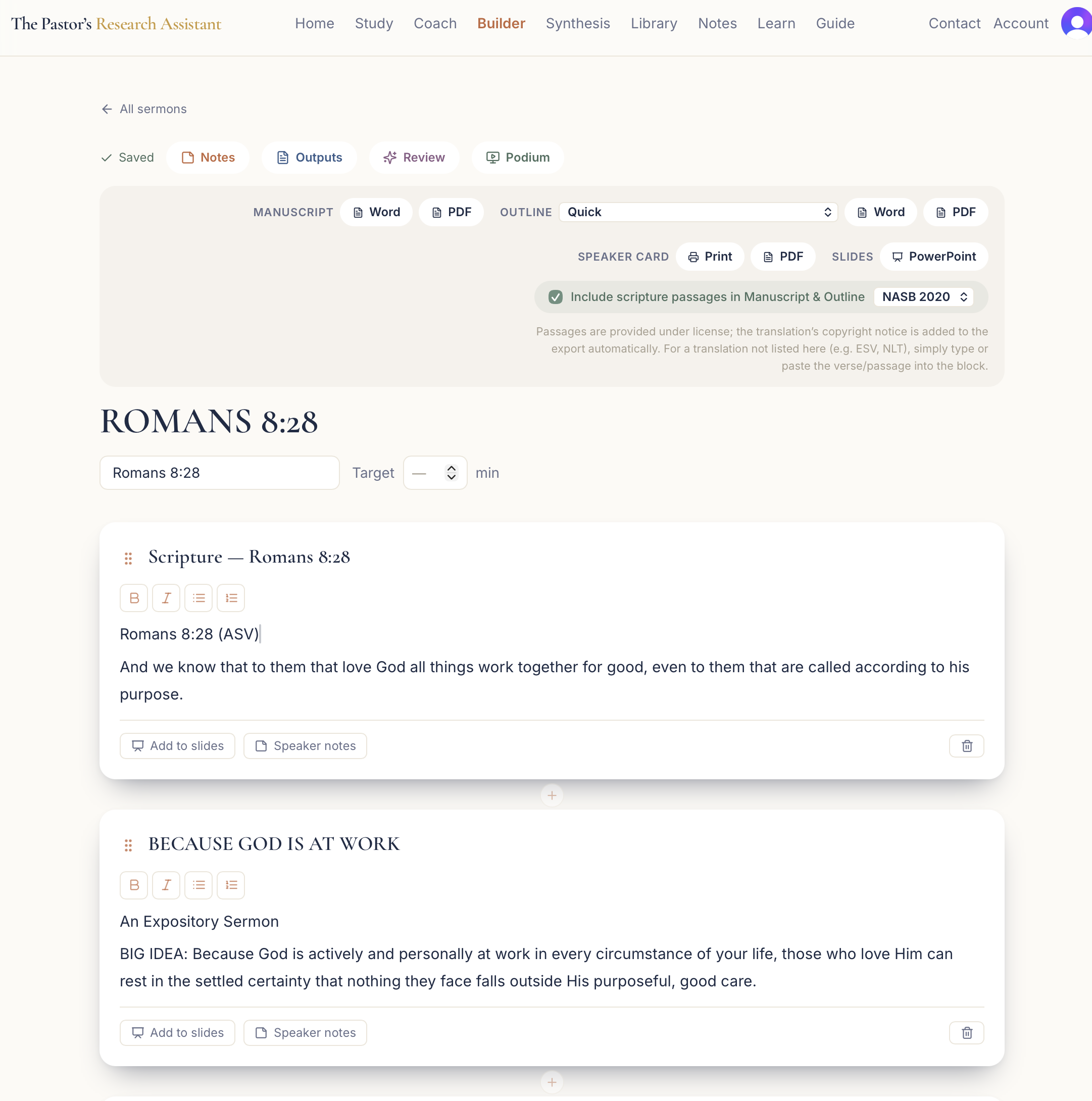
A live sermon in the Builder: drag-and-drop blocks, rich-text editing, one-click exports to Word, PDF, and PowerPoint, and your chosen Scripture translation inserted and attributed automatically.
Start from a proven form
Eight sermon templates, ready to fill
Choose the shape that fits your text and the moment. Each template loads as a set of labeled, guided blocks, the proven structure of a master preacher, ready for you to fill with your own message. The structure is the assistant’s; the sermon is yours.
Expository
Verse-driven exposition drawn straight from the text.
Introduction · Big Idea · Scripture Exposition · Points & Illustrations · Application · Conclusion
Narrative — Lowry’s Loop
A plot, not an outline: felt tension to gospel resolution.
Conflict · Complication · Reversal · Good News · Unfolding
Inductive
Begin in the particulars; let the claim emerge as discovery.
The Particulars · Exploration · Turning to the Text · The Claim Emerges · Response
Four Pages — Paul Wilson
Trouble and grace, in the text and in our world.
Trouble in the Text · Trouble in Our World · Grace in the Text · Grace in Our World
Christ-Centered — Chapell
Name the fallen condition, open the text, point to Christ.
Fallen Condition · The Text · Christ & the Gospel · Response
Problem and Solution
Name a real, felt problem; bring Scripture’s answer to bear.
The Problem · Why It Matters · The Biblical Answer · Living It Out
ME-WE-GOD-YOU-WE
A bridge from your story to common ground to the text.
Me · We · God · You · We
Blank
Start from scratch and shape your own structure.
Introduction · Body · Conclusion
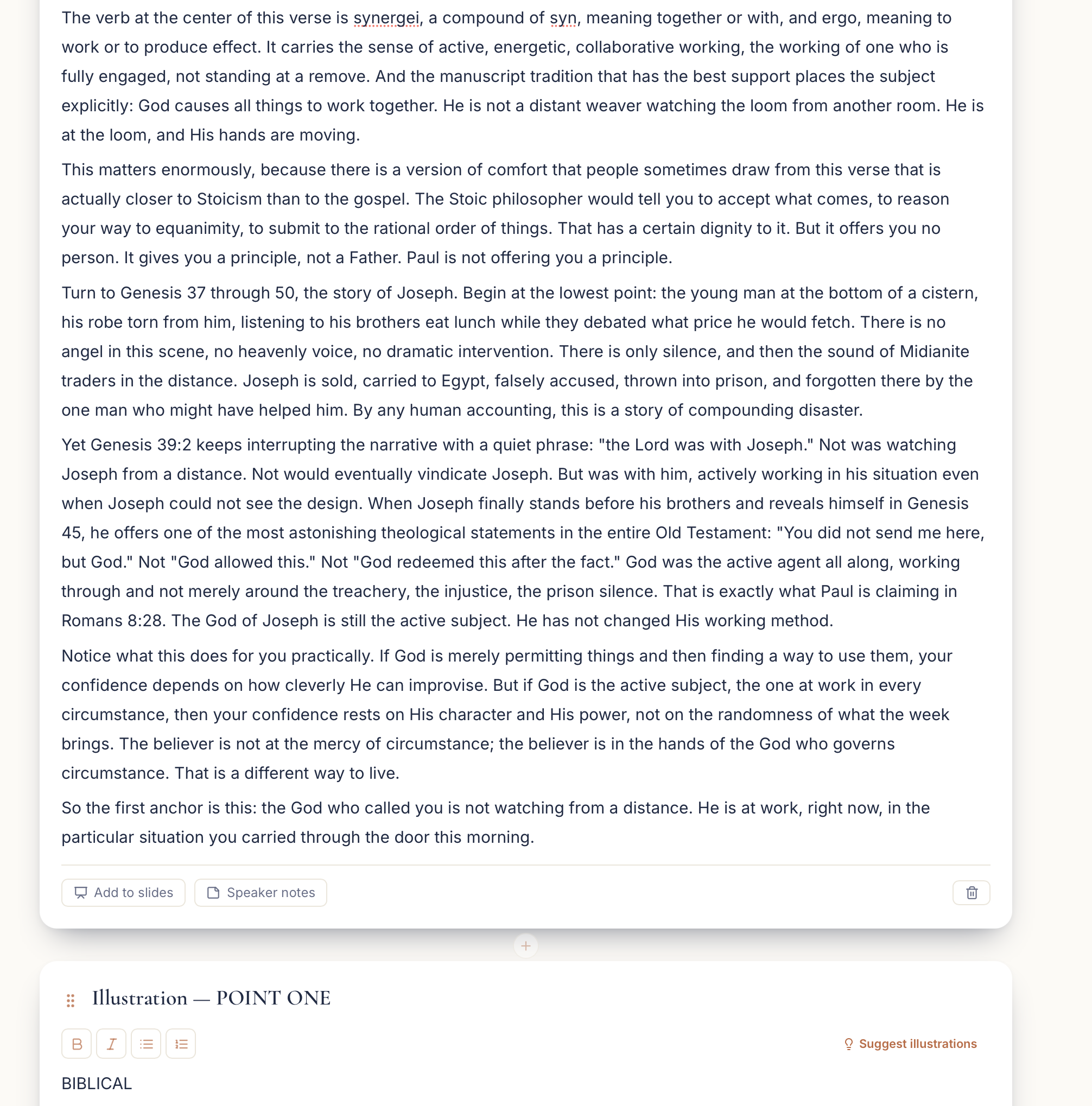
Every point, developed in full
Each point arrives as a complete, developed section, grounded in your exegesis and written in rich text you can shape line by line: bold, italics, lists, and headings, all in your own voice.
Mark any block to send it straight to your slides, attach speaker notes for the pulpit, and reorder the whole argument with a drag. The structure stays in view the entire time.
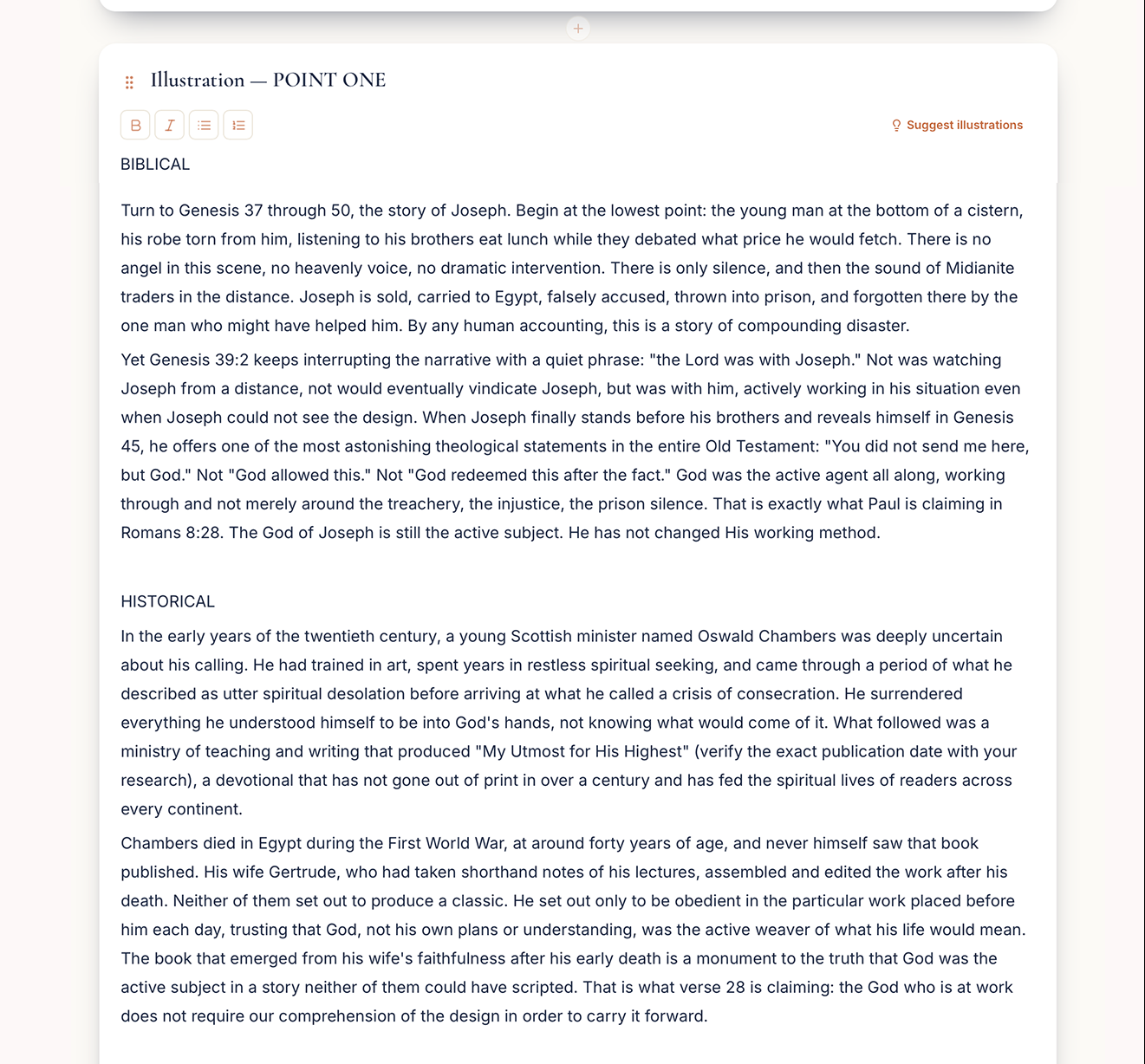
Illustrations crafted, uniquely, for each point
Stuck for an illustration? Add an Illustration block and click Suggest illustrations. The Builder draws on the full breadth of Scripture, church history, and everyday life to write complete, preachable illustrations, not vague prompts, but finished stories ready to use.
Biblical, historical, and contemporary, side by side, each one yours to preach as is, edit into your own voice, or replace. The same holds for any block: name one “Conclusion” and it drafts ways to land the message.
Drag, drop, reorder
Every part of your sermon is a movable block: Title, Big Idea, Introduction, each Point, and Conclusion. Grab the handle and reorder in seconds; split, merge, add, or remove blocks as the message takes shape, with the structure always in view.
Write it your way
Full rich-text editing inside every block: bold, italics, bullet and numbered lists, and headings. Rewrite any line until it sounds like you, and mark a block to send it straight to your slides.
Illustrations crafted, uniquely, for each point
Click Suggest illustrations and the Builder writes complete, preachable illustrations, biblical, historical, and contemporary, side by side, each ready to use, edit, or replace. Name a block “Conclusion” and it drafts ways to land the message.
Your study, in side drawers
A click away, without leaving the editor: your saved Notes library, every past analysis and generated output to read side-by-side and pull from, and an on-demand whole-sermon Review that critiques the draft like a trusted colleague.
Detailed outline
Generate a structured preaching outline straight from your blocks: main points, sub-points, and transitions, detailed enough to preach from.
Speaker’s Card
A single, at-a-glance pulpit card: title, Big Idea, each point with its key verses, the call to response, and the closing line. Built for a glance, not a read.
Slides & PowerPoint
Presentation slides generated straight from your blocks, formatted and ready for Sunday’s screen, editable in PowerPoint or Google Slides.
Podium mode
Turn your tablet or phone into the pulpit: scroll your outline or full manuscript, slide out the margin tab for the speaker’s notes you added, and track a running timer, in day or night mode.
Export anywhere
Word, PDF, and PowerPoint, cleanly formatted, with the Scripture you reference inserted in the translation you choose and properly attributed.
The Sermon Coach
You pick the passage. You pick the form. The Coach builds the sermon with you, line by line.
It knows the craft. Expository points. Lowry’s narrative turns. The trouble and grace of Four Pages. Choose your form and it develops your message in that exact shape.
It works from your exegesis. Every move grows out of your own study of the text. Nothing generic. Nothing borrowed.
It coaches at every step. The right question. Real options. A push until the line lands.
Along the way, the finer points of the craft surface again, and your skill sharpens as the sermon takes shape.
The sermon is yours. Start to finish. Built by you, with a mentor at your side.
The ten stages
Stage 3 of 10
The Big Idea
Your coach
Every point, illustration, and application exists to serve this one sentence. Choose the candidate that most faithfully carries the text.
Candidate A
Because Christ emptied himself for us, we are free to pour ourselves out for one another.
Candidate B
The humility of Christ is the pattern and the power of life together in the church.
Candidate C
God exalts the One who descends, and calls us down the same road to glory.
The ten stages
A guided path from the text to the pulpit
- 01
The Text
Name your passage and set its boundaries; your exegetical study loads in as the foundation for everything that follows.
- 02
Exegetical Foundation
Walk back through the study’s key findings, the words, the context, the theology, so the message is built on the text, not merely around it.
- 03
The Big Idea
Distill the passage into one clear, faithful, preachable sentence: the spine the whole sermon hangs on.
- 04
Sermon Type
Choose the template that fits the text and the occasion, expository, narrative, Four Pages, Christ-centered, and more; it shapes every element that follows.
- 05
Structure
Shape the movement of the message: the main points, their order, and how each one builds on the last.
- 06
Point Development
Work each point out in turn, grounded in the exegesis, with illustration and application that land.
- 07
Introduction
Craft an opening that earns attention and sets up the Big Idea.
- 08
Conclusion & Call
Bring the message home with a call to response that fits the text.
- 09
Full Manuscript
Draw every stage together into a complete manuscript, in your voice.
- 10
Review & Refine
A candid, whole-sermon critique like a trusted colleague’s, then a final polish before you preach.
The Sermon Builder shapes a message already drafted from your study; the Sermon Coach walks you through crafting one from the text up, element by element. Two paths to the pulpit, both grounded in the same deep research.
The Learning LibraryNew
Grow in your study skills by learning more about exegesis, hermeneutics, and homiletics with our built-in learning library, created for those new to interpretation and preaching, or still growing in these important skills. From foundations to advanced, with worked examples on real passages. You will find this a helpful resource in your work as a pastor, and it is included in your subscription at no additional cost.
Thirty-five lessons across three disciplines, each tiered from Foundations through Developing to Advanced. Every lesson is built to teach, not merely summarize: a worked example on a real passage, a key takeaway to carry away, and a short exercise to try on your own text this week.
Exegesis
Drawing the meaning out of the text the author actually wrote: observation, words, genre, context, and the careful use of commentaries.
Hermeneutics
Interpreting faithfully: the grammatical-historical method, bridging the gap to today, seeing Christ rightly, and avoiding the common pitfalls.
Homiletics
Turning study into a sermon: finding the Big Idea, structure, illustration and application, the narrative arc, series, and honest self-critique.
The Preaching CalendarNew
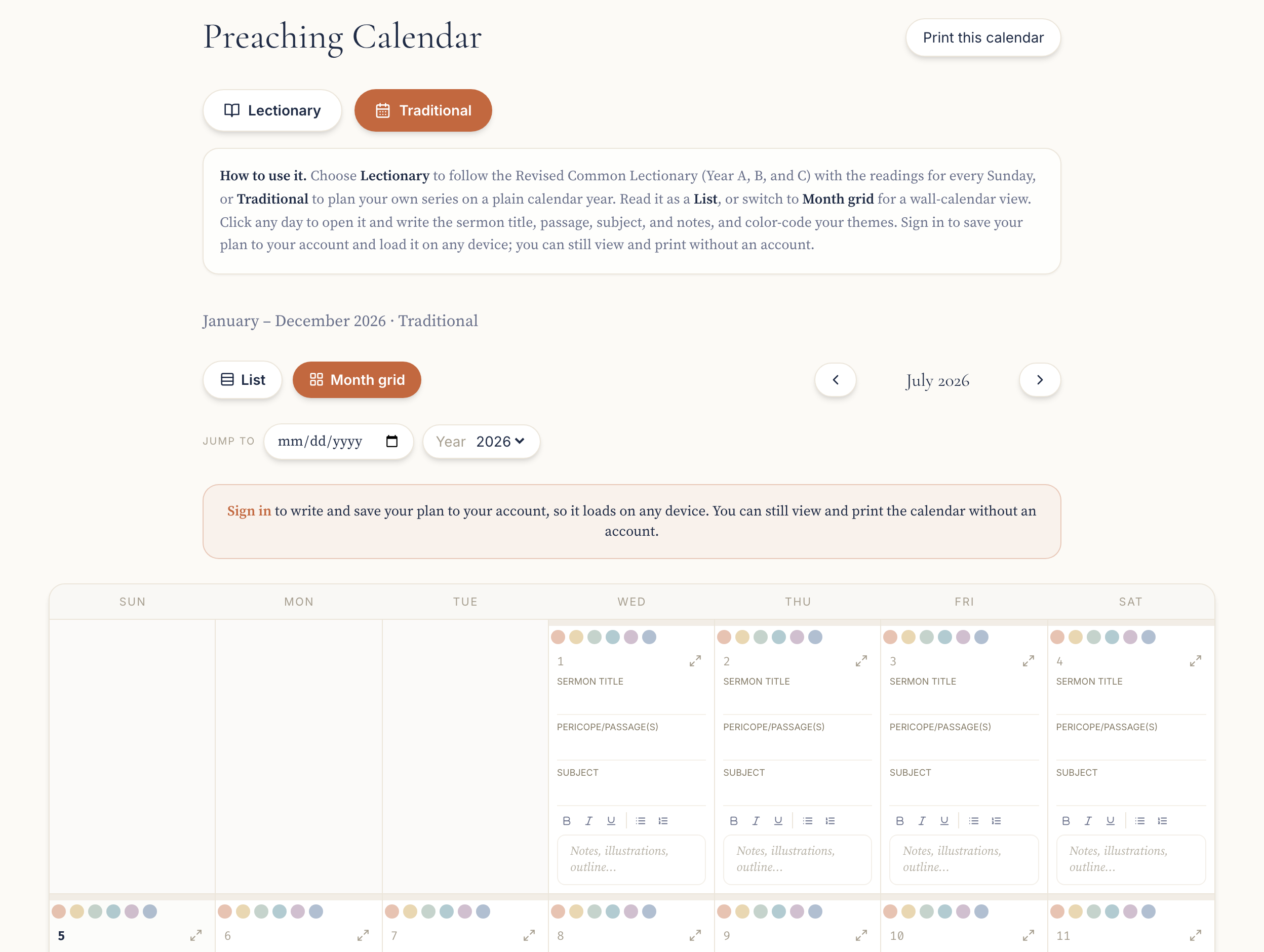
Plan your preaching a season or a year ahead, then carry each Sunday from study to the pulpit. Follow the Revised Common Lectionary (Year A, B, and C) with the readings for every Sunday, or keep a traditional calendar for your own series.
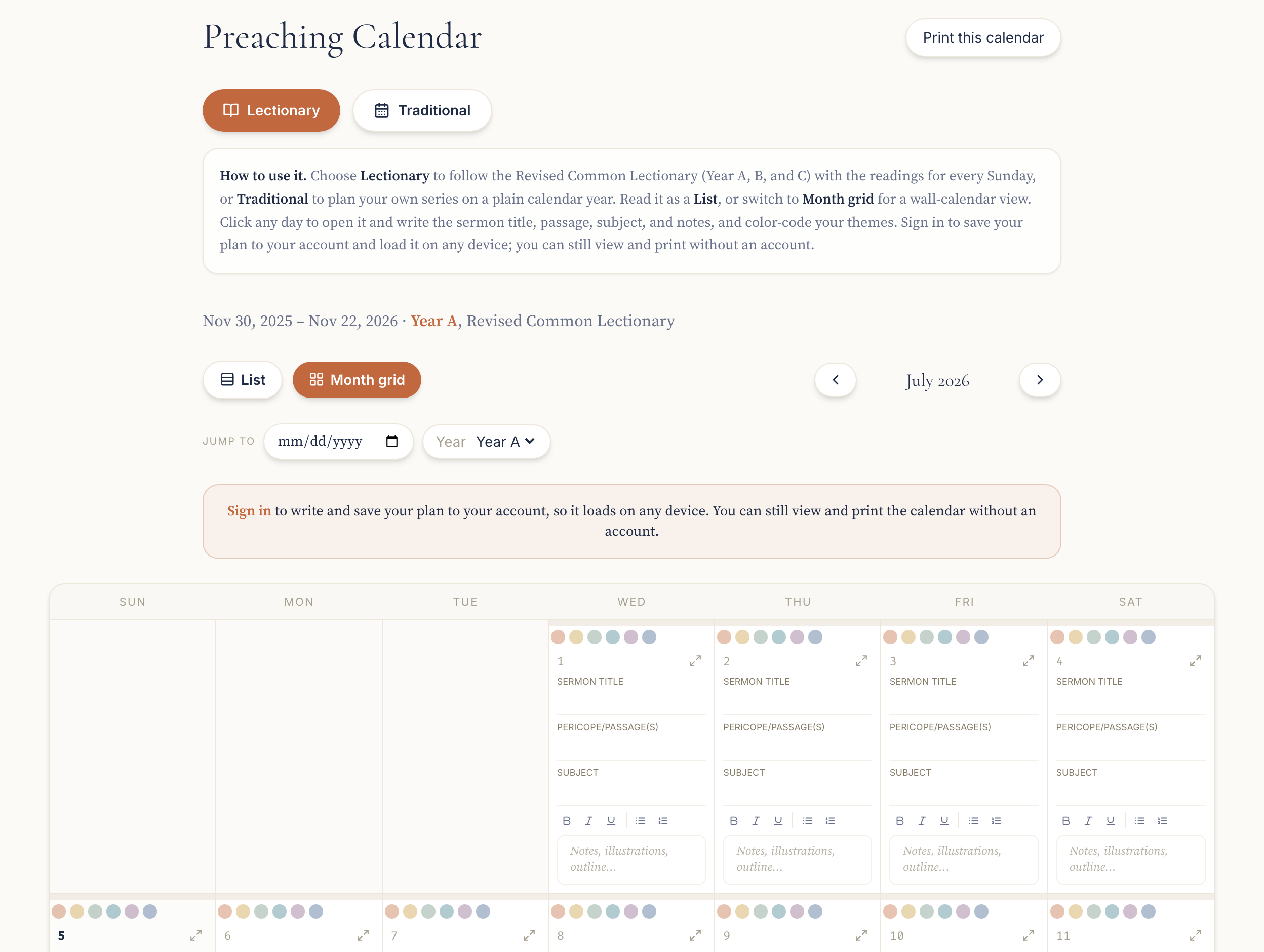
Everything in the calendar
- Two calendars: the Revised Common Lectionary (Year A/B/C) and a traditional calendar for your own series
- Two views: a season-by-season list, or a full wall-calendar month grid
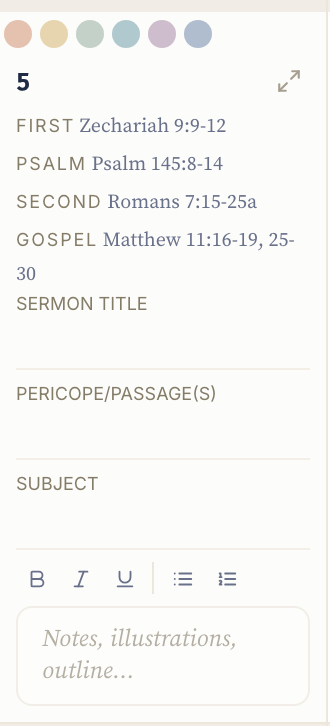
- The RCL readings, First, Psalm, Second, and Gospel, on every Sunday
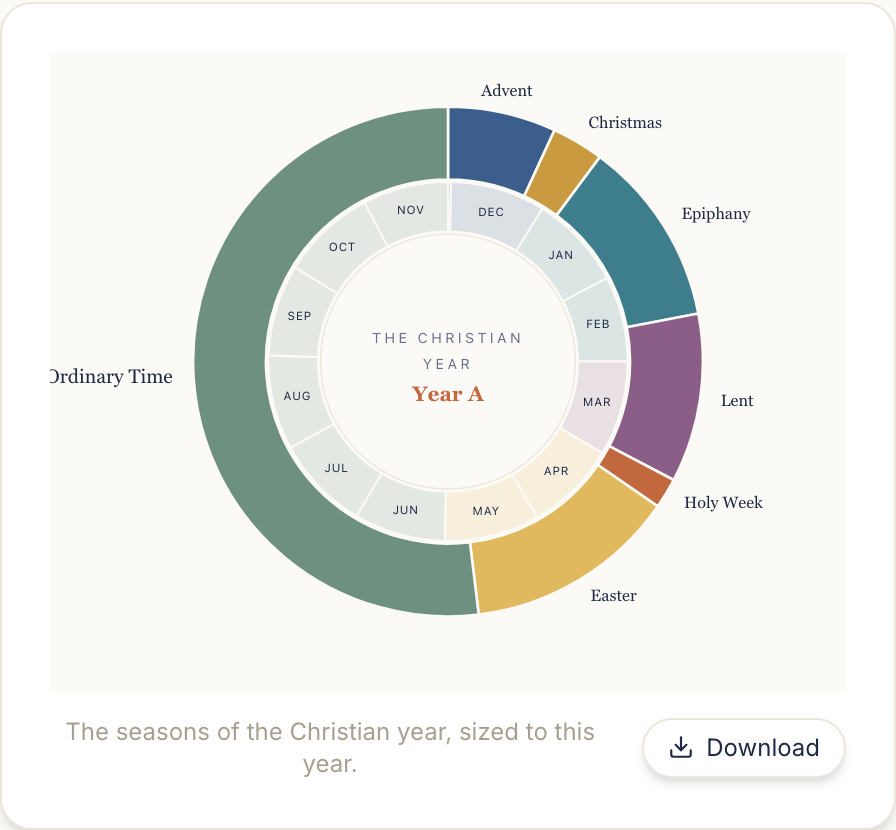
- Easter and every holy day marked for you: Ash Wednesday, Palm Sunday, Good Friday, Ascension, Pentecost, Trinity, Christ the King, and more
- A sermon title, pericope or passage(s), and subject on every day
- A rich-text notes area: bold, italic, underline, bulleted and numbered lists
- A color bar on every day to code your series and themes
- An optional midweek service day
- Jump to any date, or any lectionary Year (A, B, C), without scrolling
- Saved to your account, loads on any device, and prints any time
- A church-year wheel you can view on screen and download
It flows from your sermon work
The calendar is not a separate tool, it is where your preaching plan lives. From both the Sermon Coach and the Sermon Builder, one click, “Add to preaching calendar”, lets you choose a date and drops that sermon’s title, passage, and theme straight onto that Sunday. Your study, your sermon, and your calendar stay connected, so the work you have already done carries forward to the day you preach it.
Notes, tagged and searchableNew
Every good thought you save while you study is held in Notes, and now nothing you keep is ever lost. A search box finds any note by a word in its title, body, or passage, and #hashtags let you group and pull up your notes by theme in a single click.
Search by word
Type any word and every note whose title, body, or passage contains it appears at once, however large your collection has grown.
Tag with #hashtags
Write #prayer, #grace, or #romans8 anywhere in a note and it is tagged. There is no separate step; your tags are indexed the moment you save.
A clickable tag index
Every hashtag you use becomes a chip beneath the search box, with a count. Click to filter, combine several, or click a #tag inside any note to gather them all.